
From Super Eagles to Super Falcons: Who Is to Blame for Nigeria’s Double World Cup Disaster?
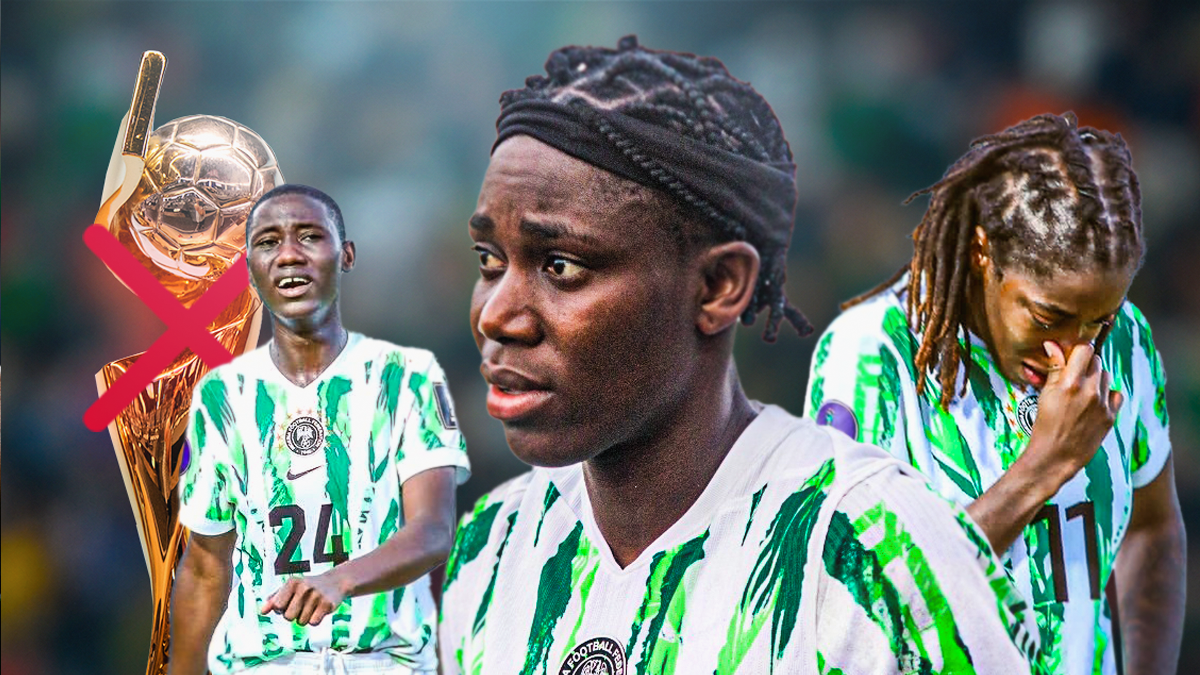
Nigeria has missed two major World Cups in less than a year.
The Super Eagles failed to qualify for the 2026 FIFA World Cup after losing to DR Congo in the African play-off. The Super Falcons then missed the 2027 Women’s World Cup after losing to South Africa in their final qualifying match.
Both failures have already led to major changes. Coaches have been removed. The Nigeria Football Federation (NFF) set up a fact-finding committee. The federation’s president, Ibrahim Gusau, General Secretary Mohammed Sanusi and the executive committee later resigned from their position.
Nigeria is now preparing for another change in its football administration.
READ ALSO: Why Every African Football Federation Should Be Studying Spain’s 2026 World Cup Success
But there is a question behind all of this: will changing the people in charge solve Nigeria’s football problems, or will the country simply start the same cycle again?
Two World Cup failures, one football crisis
The Super Eagles’ failure was painful because Nigeria had already missed the previous World Cup in Qatar.
The 2026 qualifying campaign was difficult from the beginning. Nigeria started slowly in Group C and spent much of the campaign behind South Africa and Benin.
The Eagles eventually finished second and reached the African play-offs, where they faced DR Congo in Rabat.
The match ended 1-1 after extra time before Nigeria lost 4-3 on penalties. The defeat meant the Super Eagles would miss two World Cups in a row for the first time since 1990.
The Falcons’ failure was even more shocking.
Nigeria entered the 2026 Women’s Africa Cup of Nations as defending champions and the most successful team in the competition. The Falcons had won the tournament a record 10 times and had qualified for every Women’s World Cup since the competition began in 1991.
Then came the quarter-final against Cameroon. Nigeria lost 1-0.
That did not immediately end Nigeria’s World Cup hopes because the expanded qualifying system gave teams eliminated at that stage another route. The Falcons then lost 2-1 to South Africa in the play-off, ending their hopes of reaching the 2027 tournament.
It was the first time Nigeria had failed to qualify for a Women’s World Cup since the tournament began.
Two national teams. Two World Cups missed. And two different failures that point towards the same problem: Nigeria has struggled to build a football system that can reliably turn its talent into results.
Nigeria’s first response was to look for answers
After the Falcons’ defeat, the NFF did something that has become familiar in Nigerian football. It formed a committee.
On 17 August, the federation inaugurated a fact-finding committee to investigate the poor performances of the national teams, with particular attention on the Falcons’ failure to qualify for the 2027 World Cup.
1/4 🚨 The Nigeria Football Federation has set up a fact-finding committee to investigate the country’s poor run in international competitions, with particular focus on the Super Falcons’ failure to qualify for the 2027 FIFA Women’s World Cup.— The NFF 🇳🇬 (@thenff) August 14, 2026
Former NFF General Secretary Fanny Amun chaired the six-member committee, which also included former Super Falcons captain Desire Oparanozie, former Super Eagles captain Mutiu Adepoju, former Nigeria Under-20 coach Ladan Bosso and former FIFA-badged referee Alex Mana.
The committee was asked to examine the direct and wider causes of Nigeria’s recent failures rather than simply explain one bad result.
That meant looking at issues such as player welfare, coaching appointments, camp management, scouting, talent development, league administration and governance.
The timing also mattered. The Super Eagles had experienced a public dispute over unpaid allowances during their 2026 World Cup play-off campaign, while complaints about payments and preparation have repeatedly followed Nigeria’s national teams.
So when the Falcons failed, the useful question was not only why they lost.
It was why Nigeria kept reaching this point.
The NFF’s own report points beyond the coaches
The fact-finding committee submitted its report in August. Amun resigned as chairman after handing it over, saying he wanted to protect the independence of the findings and prevent them from being influenced after the investigation had ended.
The report identified administrative, technical, financial, organisational and developmental problems within Nigerian football.
It also raised concerns about interference in player selection and coaching appointments by federation officials. These are unverified allegations, not proven findings. But the fact that a committee appointed by the NFF itself raised them shows how far concerns about the federation had spread.
If the problem were simply poor coaching, replacing the coach would be a reasonable response.
But the committee’s findings point to a wider problem. How coaches are appointed, how players are treated, how national teams prepare, how young players are developed and how decisions are made all shape what happens on the pitch.
That makes another coaching change a much smaller solution to a much larger problem.
The Super Eagles have already been through this cycle
The 2026 World Cup qualification campaign provides a clear example.
José Peseiro left after leading Nigeria to the 2023 Africa Cup of Nations final. Finidi George was appointed head coach in April 2024. He resigned in less than two months after Nigeria’s poor start to World Cup qualifying.
Augustine Eguavoen then returned as interim coach before Éric Chelle was appointed in January 2025. That is a lot of change around one qualification campaign.
Yet Chelle did improve the team.
CAF records that, in his first six World Cup qualifying matches after taking charge, Nigeria won four and drew two, having 14 points from a possible 18.
Nigeria moved from a difficult position into contention for the play-offs.
Chelle still failed to take the Eagles to the World Cup. But the improvement during his first six matches is useful evidence against the idea that every problem can be solved by replacing the coach.
A new coach needs time to understand the players, build a system and establish working relationships with the federation. When the national team repeatedly changes direction, that process keeps starting again.
That is not rebuilding. That is restarting.
The Falcons offer an even bigger warning
Randy Waldrum left the Super Falcons in September 2024 after leading Nigeria to the 2023 Women’s World Cup and helping the team qualify for the 2024 Olympics. He cited his wife’s health as the reason for leaving.
Justin Madugu took over and then won the 2024 WAFCON, which was played in Morocco in 2025. Nigeria won its 10th continental title under Madugu and went through the tournament unbeaten.
Yet less than two years later, Madugu was gone.
After the Falcons lost to Cameroon in the WAFCON quarter-finals and then to South Africa in the World Cup play-off, the NFF dismissed Madugu and his technical crew.
The decision can be defended on sporting grounds. Nigeria’s campaign had ended badly.
But it still raises a question about continuity. If a coach can win the continental title and then be removed after the next major failure, what is the long-term plan?
Where is the line between demanding results and building a team?
Nigeria’s money problems make the situation worse
The football crisis is also about money.
In August, reports emerged that the Economic and Financial Crimes Commission (EFCC) and the Independent Corrupt Practices and Other Related Offences Commission (ICPC) were investigating the use of a ₦12 billion ($9 million) Federal Government intervention fund released to the NFF for players’ wages, allowances and bonuses.
The NFF disclosed the investigation in an 18 August response to a Freedom of Information request, according to The Times Nigeria. PUNCH also reported that investigators had invited officials connected to the fund.
The investigation does not mean the NFF has been found guilty of misusing the money. That distinction is important.
But the investigation comes at a difficult time. Players have repeatedly complained about unpaid money, while the Super Eagles had an allowance dispute during their World Cup play-off campaign.
Those disputes can affect preparation and trust before a team even steps onto the pitch.
Imagine preparing for the biggest match of your national-team career while there is uncertainty over money you believe you are owed.
This is a management problem, and management problems cannot be solved by changing a formation.
The crisis finally reached the top
The pressure eventually reached the NFF leadership.
On 27 August, Gusau resigned as NFF president, while Sanusi, the federation’s General Secretary, and the executive committee members also stepped down. Gusau said his resignation was intended to create room for a comprehensive reform process addressing the institutional, governance and development problems facing Nigerian football.
The National Sports Commission subsequently approved Emmanuel Ikpeme, a former NFF Deputy General Secretary, to oversee the federation’s secretariat as interim General Secretary. The NFF’s planned 27 September elective congress was also suspended, with a new electoral process expected after the reform exercise.
FIFA and CAF have directed NFF to suspend its electoral process and announced plans to send a joint assessment mission to Abuja.
President Bola Tinubu has also directed a comprehensive reform of Nigerian football, with governance, administration, development pathways, domestic competitions and accountability among the areas to be addressed.
There is now a genuine opportunity to change how Nigerian football is run.
But there is also a danger that the country will confuse a change of leadership with a change of system.
Former Nigeria international and football administrator Segun Odegbami made the same point after the NFF resignations, warning that replacing the federation’s leadership alone would not resolve the problems that have built up over decades.
That warning is important because the current crisis has already produced its most visible consequence: new people are preparing to take over.
The bigger question is what they will inherit.
The problem is not a lack of talent
Nigeria has the audience, the players and the continental history. What it has failed to build is the system that holds those things together.
Other African teams are now closing the gap. The evidence is visible across both the men’s and women’s game.
South Africa, Morocco and Zambia have strengthened their women’s teams, while countries such as DR Congo, Benin and South Africa have also made the Super Eagles’ route to major tournaments more difficult.
Nigeria’s football history and old advantages still matter. But they no longer guarantee results.
The danger now is that everyone mistakes a new leadership team for a new football system. Nigeria has already started over many times. The next test is whether it can finally build a successful team.
About the Author

0 Comments